
Updated
—
11 min read
How I Cut My Sleeping CO₂ in Half for $30
CO2 will kill your sleep quality. Here's how I fixed it.
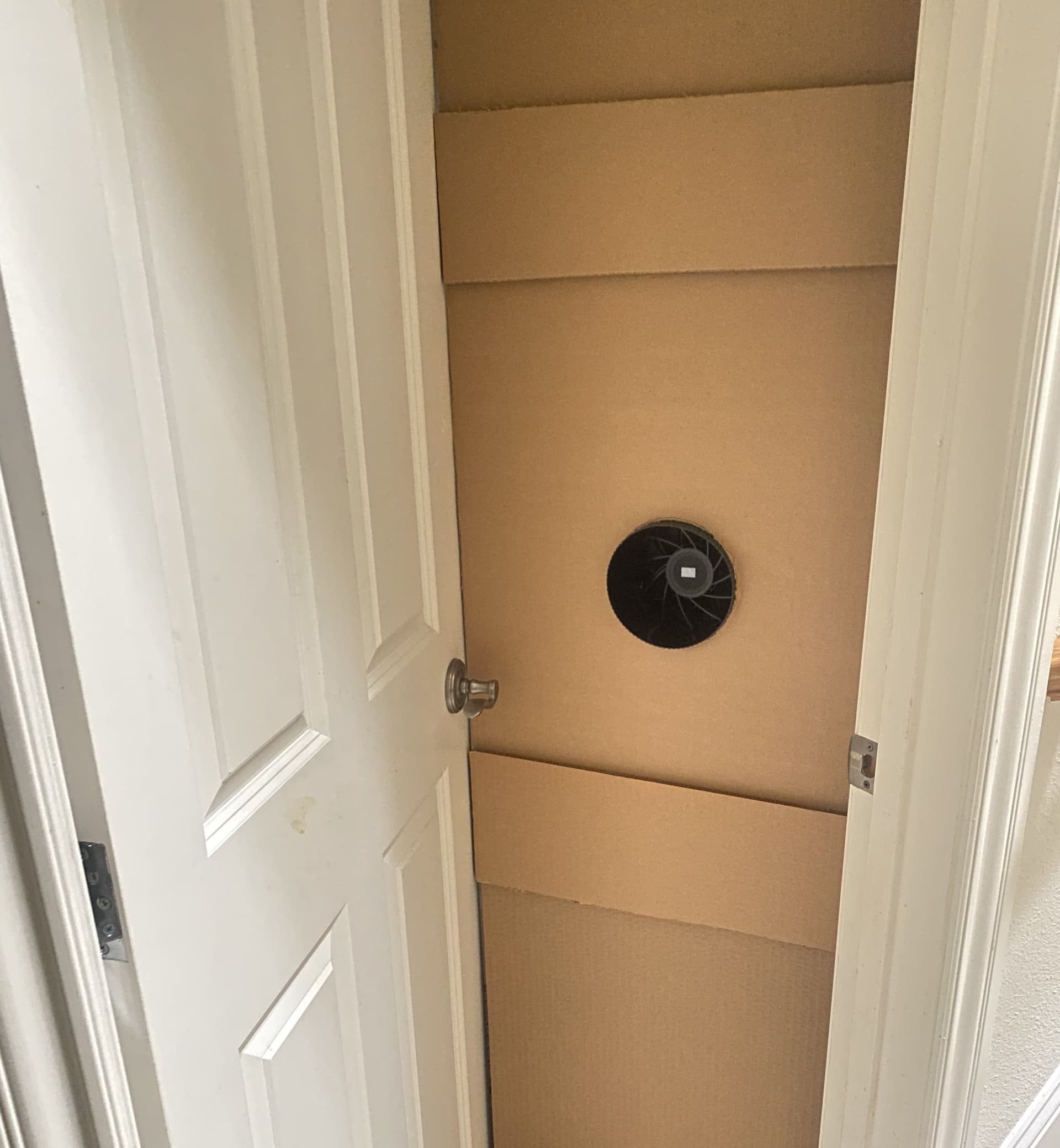
My DIY solution for dramatically reducing CO2 build up overnight
I'm one of 60.9% of the population that sleeps with a closed door.
To me, a closed bedroom door offers better noise control, blocks out light, and is private — all of which are important for my sleep quality.
But since getting my Aranet4, I noticed that CO2 levels would rise significantly in such a closed environment.
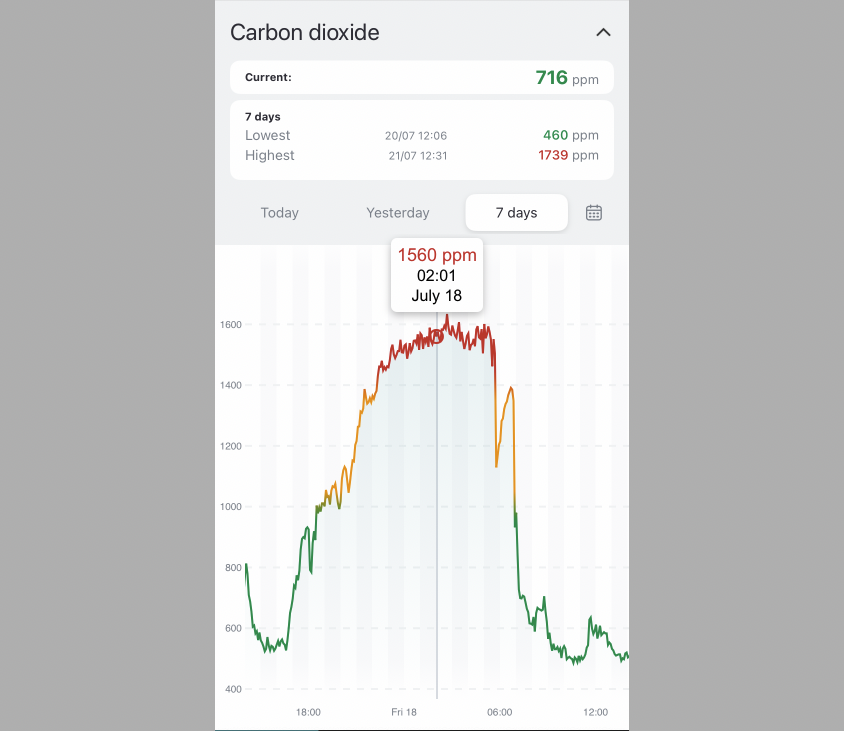
Humans exhalation CO₂ concentration is ~40,000 ppm. [1]
With adequate ventilation, this high CO2 level is quickly dispersed. But without ventilation (such as a HVAC running or open windows), closed environments can easily exceed 1000–1500+ ppm overnight.
I would wake up most mornings with readings of 1500+ ppm and noticeably worse sleep quality (mild headaches, grogginess, etc.) despite otherwise strong sleep hygiene.
NoteYou don’t need a fancy sensor to benefit from this. The fan setup works whether you can measure CO₂ or not—I just used the Aranet4 to validate it. If you're curious about air quality but don’t want to drop $200, even a $40–80 CO₂ sensor (like an Inkbird or Temtop) can help validate airflow changes.
High CO2 will kill your sleep quality
There are robust studies on the effects of CO2 concentration on human cognition and sleep quality:
Ventilation causing an average CO2 concentration of 1,000 ppm negatively affects sleep
"Significantly higher salivary cortisol levels after waking suggest that acute stress and increased sympathetic nervous system activity caused the negative effects on sleep that were observed."
"Group average cognitive performance did not differ significantly between conditions but at the individual level reduced sleep quality was significantly correlated with reduced cognitive performance."
Experimental study on sleep quality affected by carbon dioxide concentration
"A linear positive correlation was found between sleep onset latency (SOL) and CO2 concentration"
"Both subjective and physiological results showed that sleep quality decreased significantly with the increase of CO2 concentration"
"...when exposed to the high level of occupant pollution with the average CO2 concentration being 2000 ppm, subjects reported lower satisfaction on sleep and less easiness of awakening, and experienced a shorter duration of total sleep and deep sleep stage, which indicates a worse sleep quality."
"Furthermore, fractional CO2, end-tidal CO2 and systolic blood pressure measured in the morning were significantly higher."
"The change of LF/HF ratio of heart rate variability was significantly more at the onset of sleep and less during arousal. This suggests that when sleeping in an occupant-polluted environment, subjects experienced a slower automatic nervous system transition from a sympathetically dominated state to a parasympathetically dominated state at night, and vice versa in the morning."
The Influence of Bedroom CO2 Concentration on Sleep Quality
"N3 is a deep sleep stage, also called slow-wave sleep, which is of great significance for sleep, it is reasonable to choose the proportion of the N3 stage as the representation of sleep quality in this paper. According to the above statistical analysis results, CO2 concentration has an impact on sleep quality, and the higher the CO2 concentration, the more obvious the impact on sleep quality."
Ventilate your bedroom at night. You perform better the next day
"Above 1150 ppm: Insufficient ventilation—sleep quality will be adversely affected. CO2 levels that are higher than 1150 ppm will typically occur in bedrooms that are not fitted with a ventilation system and where windows and doors are closed."
Even without such studies, I subjectively experience worse sleep in a closed environment. So a solution was needed.
Disregarding the obvious solutions
The obvious solution is to sleep with a window open or simply open your bedroom door.
Having an open window significantly aids CO2 levels, as the global average outdoor CO2 concentration is ~420ppm. [2]
An open window however can also introduce noise (traffic, animals, people), privacy concerns, temperature variability (hot summers, cold winters, precipitation, etc.) and potentially safety concerns if you live on a ground level.
Sleeping with your bedroom door open is also effective at reducing CO2, providing that the rest of your living space is better circulated (often hallways and entryways are). But like an open window, an open door can introduce:
- Light
- Noise
- Privacy concerns — especially if you don't live alone.
If it's an option for you, sleeping with a window open is definitely the easiest (and free) option for improving CO2 concentration overnight.
But for the reasons above, I needed another solution.
The constraints
I wanted a solution that could achieve these requirements:
- Door must remain "closed" (light, noise, privacy)
- Significantly reduce CO2 buildup overnight
- Rent-friendly (no permanent modifications like screws, drywall cutting, etc.)
- Quiet enough to run all night
- Cheap and fast to prototype
- Bonus if modular or removable
Building a solution
I first bought a inline duct booster fan, designed for increasing airflow in ventilation systems.
These fans are meant to be installed in ductwork to distribute air more effectively, but for my use case it was perfect for being lightweight, quiet, and powerful at pulling air.
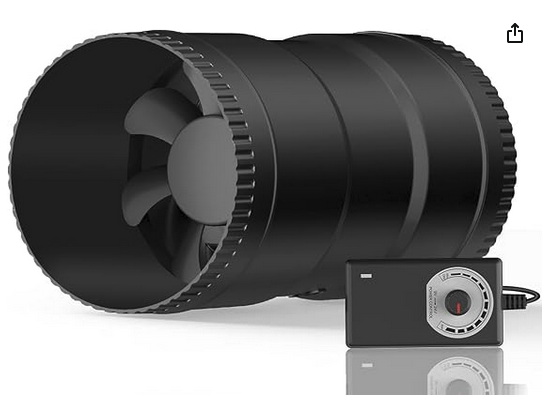
I chose the Hon&Guan 6 Inch Inline Duct Booster fan for being cheap (~$30), lightweight (1.9 lbs), and (supposedly) quiet.
At this point, I could leave my door ajar and place the fan inside the gap, but this wouldn't mitigate noise, light, and privacy concerns.
Instead, a cardboard panel could fit perfectly in the gap of the door:
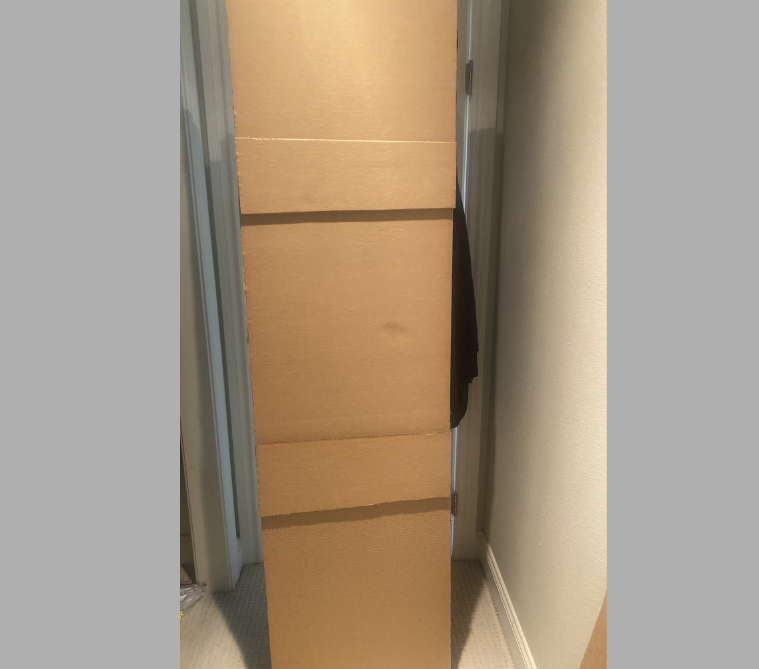
This is just three sheets of double-walled corrugated cardboard glued together with ~6" backing strips and hot glue.
Then simply traced and cut a hole for inserting the inline duct fan:
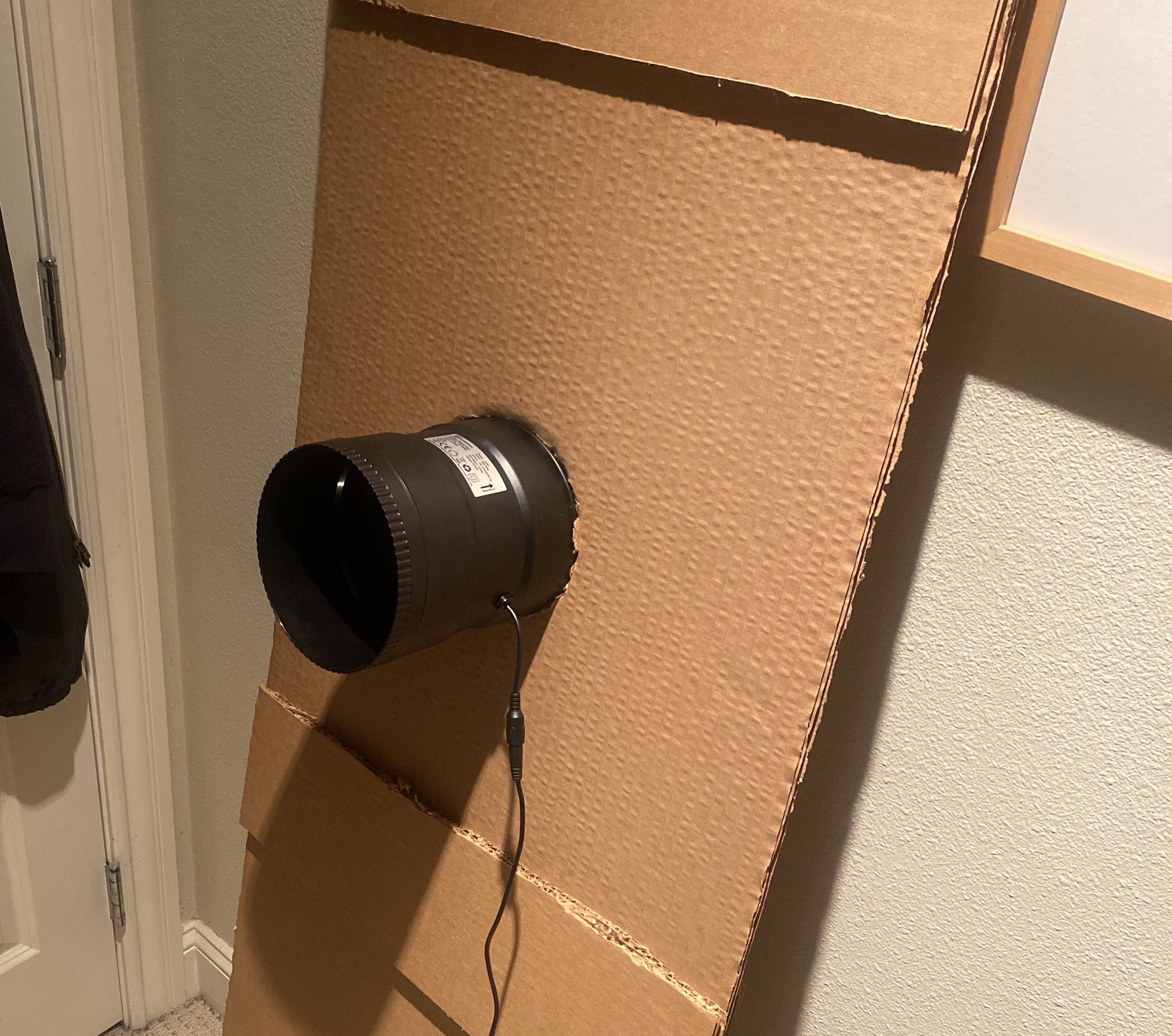
The inline fan I chose had a weight of around 1.9 lbs, which was very lightweight and easily mounted into the cardboard without any glue or mounting devices.
I made the hole slightly smaller than the diameter of the fan so it had a snug fit and wouldn't rattle around.
Then I was able to fit the panel + fan into the door gap, blocking light and helping with noise (though not perfect, admittedly):
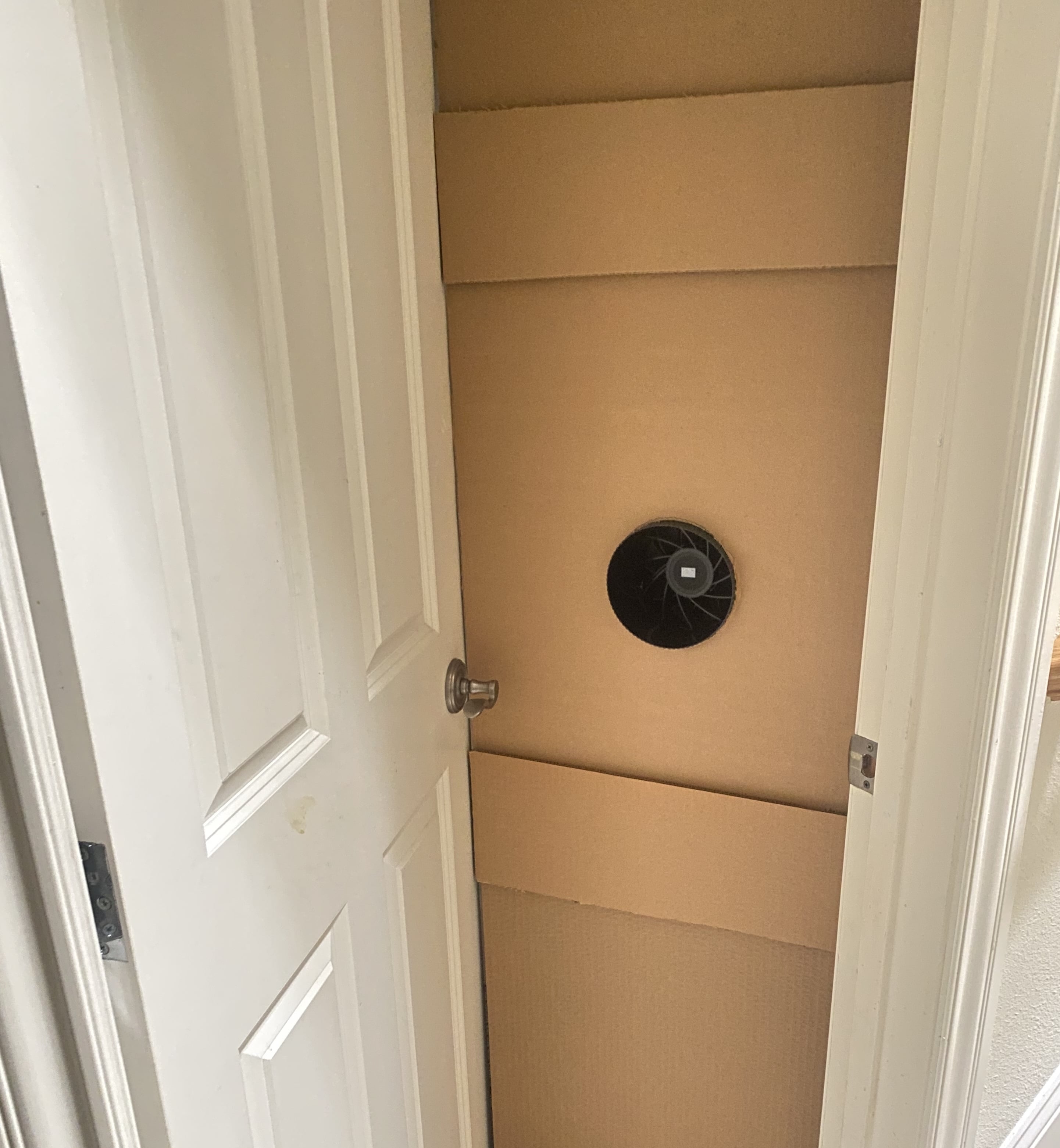
I used a weight to hold the door flush with the panel and prevent it from accidentally opening or falling overnight.
NoteImportantly, I faced the fan blowing outwards. My thinking was that this would pull stale air out of the bedroom, creating lower pressure that would pull fresh air in from the cracks around the panel and under the door.
The results!
It’s a deceptively simple hack (cardboard + glue + fan), but sometimes those are the best kind. Simple physics, validated by data.
And after testing it out, here are the results:
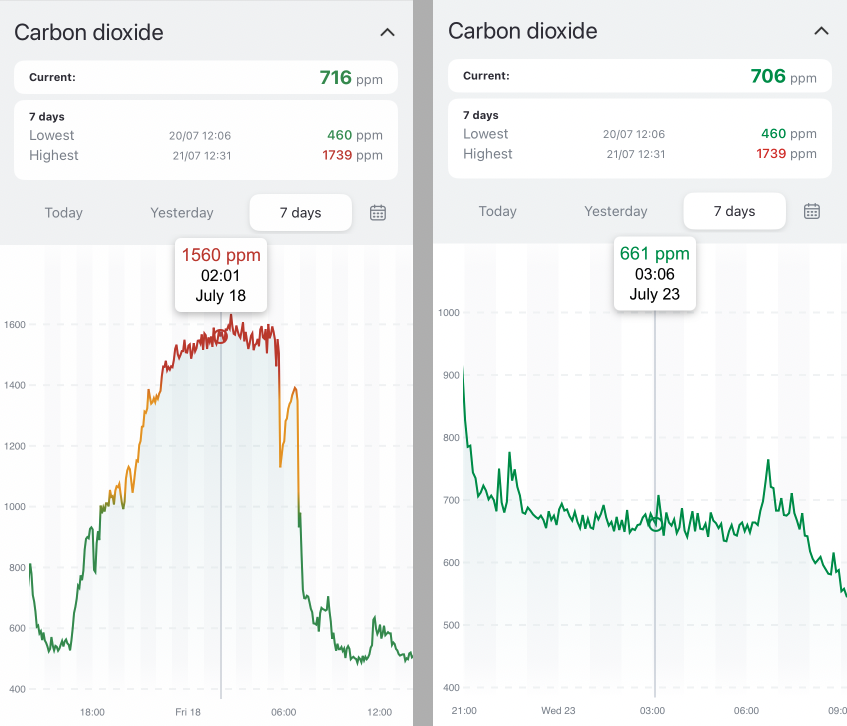
The left hand graph from the Aranet4 app shows my normal, closed-door sleeping environment. The right hand side shows the first night using my new contraption.
At the same time of night, CO2 levels were ~650ppm, compared to earlier levels of 1500+ ppm.
This DIY solution effectively reduced CO2 levels by more than half, while being entirely removable, blocking light leakage, reducing noise (not as well as a closed door, but decently), and maintaining privacy.
It costs <$0.50/month in electricity to run the fan at lower power at night.
Confirming the results
To confirm the results, I also ran a mini control test where I put the panel in place, but did not run the fan.
I then stayed in the bedroom for several hours, mimmicking sleep. At the end of this, CO2 levels had risen to ~1100ppm and possibly would've continued higher if I continued the experiment.
This final test confirms a few things:
- The panel / door gaps alone do not meaningfully improve ventilation
- The dramatic drop in CO2 (1500+ ppm to 650ppm) is clearly attributable to the fan-driven airflow, rather than any minor leaks in the setup
- There is likely active air exchange through pressure differentials being created
Estimating airflow rate (CFM)
The inline fan I used was advertised as having an airflow rate of 345 cubic feet per minute (CFM).
Given a bedroom size of ~1500 cubic feet (estimated based on averages), at max power this would theoretically exchange all air in that room in about 4.3 minutes.
But I am not running the fan at full power, rather say 20% power.
If we assume near-linear behavior of airflow to power input, we would get ~69 CFM, or 21.7 minutes to exchange 1500 ft³.
To estimate airflow more accurately, I used the Aranet4 to track how quickly CO₂ levels dropped with the fan running at ~20% power.
Using an exponential decay model for indoor air ventilation:
C(t) = C_out + (C₀ - C_out) * e^(-λt)
Solving for the air exchange rate λ:
λ = -1 / t * ln( (C(t) - C_out) / (C₀ - C_out) )
Then:
ACH = 60 × λ CFM = (ACH × Room Volume in ft³) / 60
To get data, I closed the door with the panel in place and turned off the fan, again letting CO2 build up.
When the CO2 was at 1151 ppm, I turned on the fan and waited. Over 30 minutes the CO2 concentration dropped to 865ppm, with an assumed "outdoor" (hallway) baseline of 420 ppm, and a room volume of 1200 ft³. Plugging into the formula:
λ ≈ 0.01657 ACH ≈ 0.994 CFM ≈ 19.88
So despite the fan being rated at 345 CFM at full power, it's likely moving closer to ~20 CFM at this setting — much more realistic for low-speed operation.
This is a very rough estimation, but suggests the entire room's 1200 ft³ is being exchanged every ~1 hour the fan is running.
Over the course of an 8-hour night, the air in the room is effectively being exchanged 8 times over, which easily could explain how it never rises above ~650ppm.
Takeaways (fire risk? improvements?)
I'm quite pleased with its effectiveness and affordability as a DIY solution.
And until I can find more permanent solutions to CO2 buildup, this was worth the $30.
I figure the fire hazard risk is low (but not zero) given that:
- The fan is CE-rated (though unfortunately this doesn't mean much, and it's not UL or ETL listed)
- Not obstructing or overheating
- It's run at low power (~19W or less)
- Wiring isn't frayed or DIY-spliced
- Cardboard isn't touching exposed metal or motors
If I were to make this more permanent, I would swap in a ETL or UL listed fan (like this one), choose non-flammable construction material such as fire-rated rigid foam board, and possibly a smart plug with surge protection for automated control and safer overnight use.
I might also consider sealing the panel perimeter with foam gasket strips to reduce noise and improve pressure control.
Warning⚠️ Standard disclaimer: use common sense. Don’t use a damaged fan, make sure your electronics are rated for continuous use and ventilated, and never leave a janky setup unattended unless you trust it. This post is not meant to encourage accidental house fires.
Of course, this isn’t a double-blind sleep study—I’m one person, and this setup just made a big difference for me. But the CO₂ data is clear, and the rest aligns with what the research suggests.
If you try this build—or improve on it—I’d love to see what you come up with. Feel free to message me or share your version.
Thanks for reading!
Join my newsletter for lessons, experiments, and failures in bootstrapping online businesses.
Sign up if you're curious. I’ll only email you if it's actually good.

Meet the Author
Ryan Chiang
Hello, I'm Ryan. I build things and write about them. This is my blog of my learnings, tutorials, and whatever else I feel like writing about.
What I'm currently building →.